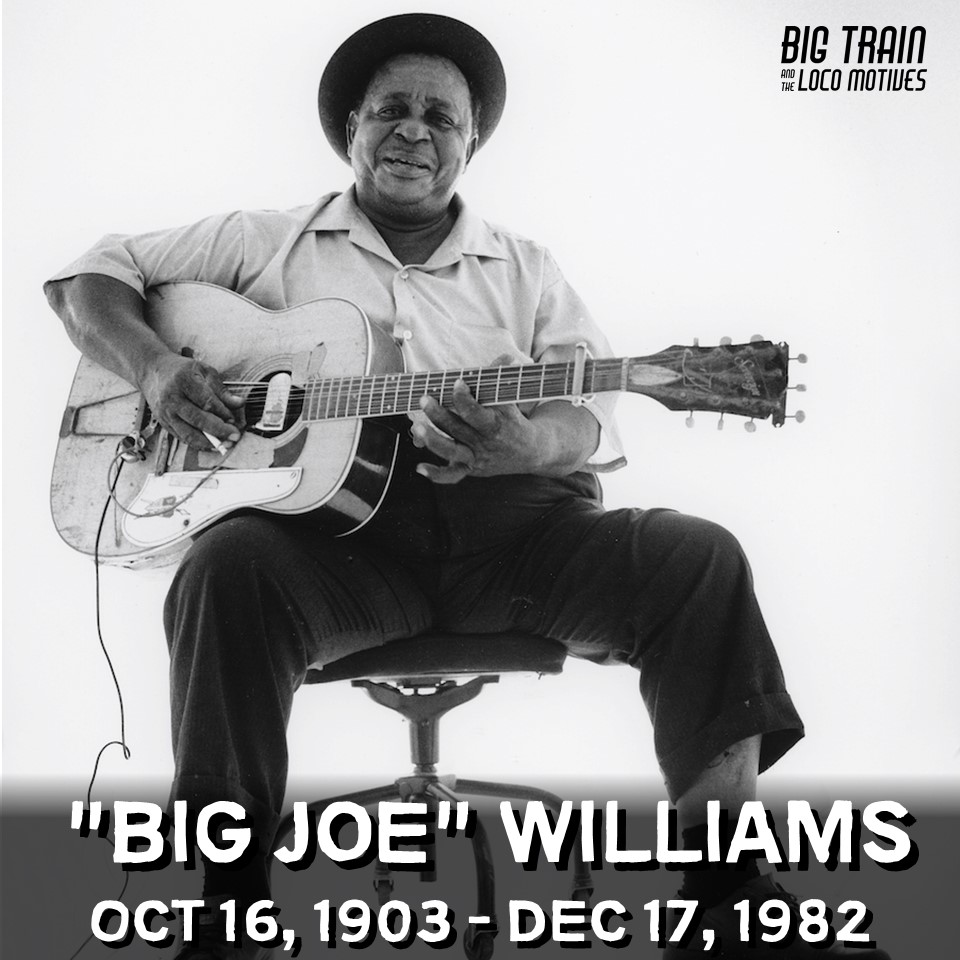
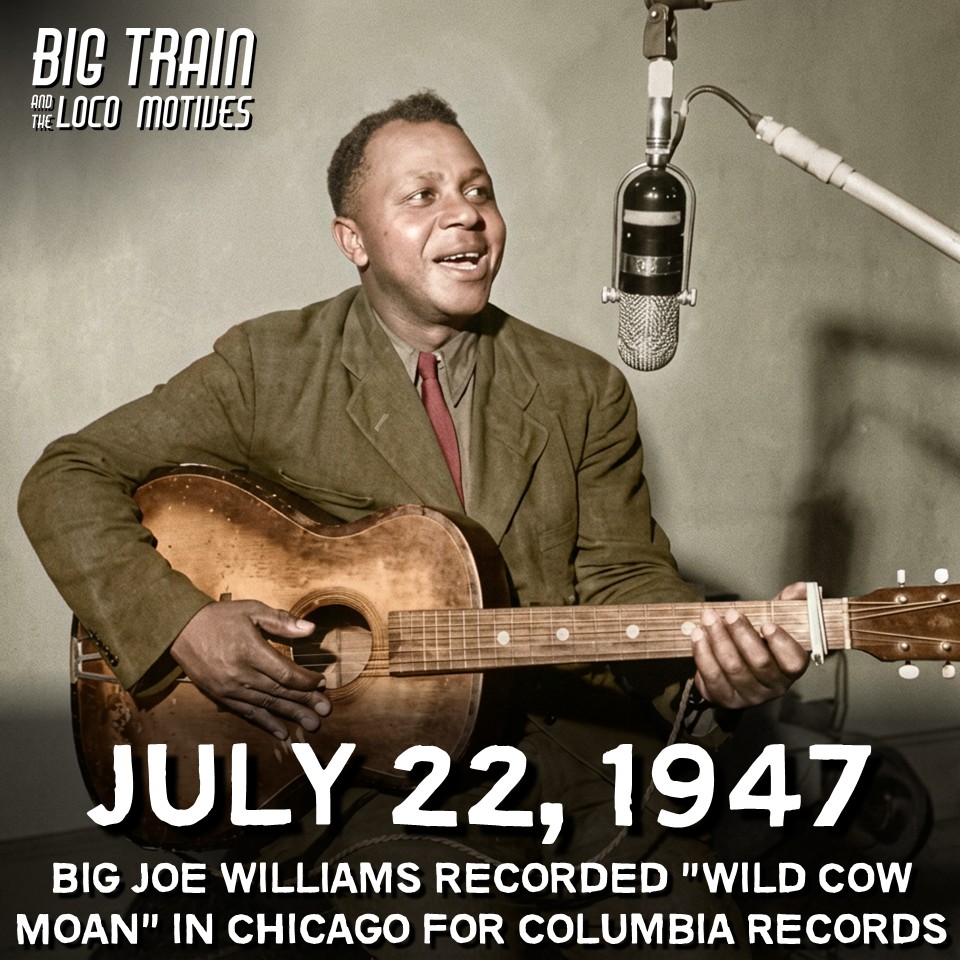
HEY LOCO FANS – On July 22, 1947, Big Joe Williams gathered an extraordinary group of musicians at Columbia Records’ Chicago studio to record “Wild Cow Moan,” a performance that perfectly captured the blues during its transformation from rural Delta music to the electrified sound of postwar Chicago. The session showcased Williams at the height of his powers, wielding his trademark nine-string guitar and delivering the forceful vocals that had already made him one of the most respected bluesmen of his generation.
Born Joseph Lee Williams on October 16, 1903, in Crawford, Mississippi, Williams learned his craft while traveling throughout the South, absorbing the music of Delta pioneers and developing a hard-driving style unlike any other guitarist. His heavily modified nine-string guitar produced a fuller, more percussive sound that became his signature. During the 1930s, his recordings for Bluebird Records, especially “Baby Please Don’t Go,” established him as one of the most influential country blues artists in America.
By the summer of 1947, blues music was rapidly evolving. As musicians migrated north, bands added bass, drums, and amplified instruments, creating the foundation of Chicago blues. Williams embraced these changes while remaining rooted in the Delta tradition. For the Columbia session, he was joined by harmonica master Sonny Boy Williamson I, bassist Ransom Knowling, and drummer Judge Riley. Their tight, driving accompaniment added urban sophistication without sacrificing the raw emotion that defined Williams’ music.
“Wild Cow Moan” drew inspiration from the long-running “milk cow” blues tradition popularized by musicians including Kokomo Arnold, yet Williams transformed the familiar theme into something tougher and more urgent. His pounding guitar rhythms, booming voice, and Williamson’s razor-sharp harmonica combined to create one of the strongest performances of Williams’ Columbia years. During the same session, the quartet also recorded a fresh version of “Baby Please Don’t Go,” along with “Stack of Dollars” and “Mellow Apples.” Columbia later paired “Wild Cow Moan” with “Baby Please Don’t Go” on a 78 rpm release issued in October 1947.
Although “Wild Cow Moan” never became a commercial hit, it has earned lasting recognition as one of the finest examples of blues in transition. The recording bridges the gap between the acoustic Delta sound of the 1930s and the powerful Chicago blues style that would soon be popularized by artists such as Muddy Waters and Howlin’ Wolf. It also stands among the final studio collaborations between Williams and Sonny Boy Williamson I, who was tragically killed in 1948. More than 75 years later, “Wild Cow Moan” remains a vivid reminder of Big Joe Williams’ enormous influence on both traditional blues and the electric blues revolution that followed.
Big Joe Williams – “Wild Cow Moan”
Big Joe Williams’ “Wild Cow Moan” helped bridge Delta blues and Chicago’s electrifying postwar blues revolution.
Related Posts