
HEY LOCO FANS – Jessie Mae Hemphill was born Jessie Mae Graham on October 18, 1923, in the North Mississippi hill country near Como and Senatobia. She came from a musical family stretching back generations. Her great-grandfather, Dock Hemphill, was a fiddler born into slavery, while her grandfather, Sid Hemphill, became one of North Mississippi’s great multi-instrumentalists and fife-and-drum masters. Alan Lomax recorded Sid in 1942 and again in 1959. Jessie Mae’s mother, Virgie Lee, and her aunts also played drums and stringed instruments. Around this family, music was less a hobby than household equipment.
 Hemphill began playing guitar around age seven and learned drums as well, eventually playing snare and bass drum in local fife-and-drum bands. She lived periodically in Memphis during the 1940s and 1950s, working jobs including waitress and elevator operator while occasionally sitting in with musicians at local clubs. Most of her music, however, remained centered on family gatherings, picnics and the rural musical traditions of North Mississippi.
Blues researcher George Mitchell first recorded Hemphill in 1967. Ethnomusicologist David Evans recorded her again in 1973, but neither session initially produced a commercial release. Mitchell’s 1967 recordings remained unheard commercially until Fat Possum issued them decades later.
When Evans joined Memphis State University, now the University of Memphis, he became closely involved with its High Water Recording Company. He recorded Hemphill again beginning in 1979, producing the sessions that finally pushed her music beyond the Mississippi hills. Her first single, “Jessie’s Boogie,” backed with “Standing in My Doorway Crying,” appeared on High Water in 1980.
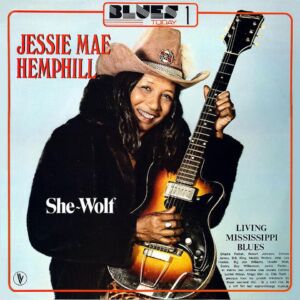
Her first album, She-Wolf, was issued by the French Vogue label in 1981. Its music was wonderfully spare. Hemphill could create an enormous groove with electric guitar, voice and foot-operated tambourine, sometimes adding ankle bells. Instead of piling chord changes on top of the blues, she often settled into repeating modal riffs that could become almost hypnotic. The rhythmic influence of the fife-and-drum tradition was never far away.
Hemphill soon carried that sound across the United States, Canada and Europe. She also remained connected to the fife-and-drum music of her childhood. In 1982 she and Abe Young played drums behind fife master Otha Turner on Mister Rogers’ Neighborhood. Yes, Fred Rogers once brought Mississippi fife-and-drum blues into America’s living rooms. That neighborhood was considerably hipper than many of us realized.
Her first full-length American album, Feelin’ Good, grew from sessions produced by Evans and showcased songs including “Feelin’ Good,” “Streamline Train,” “Shame on You,” “Eagle Bird” and “Lord, Help the Poor and Needy.” Hemphill wrote much of her own material while also reshaping traditional songs and older blues into her distinctive rhythmic language.
 Recognition followed. Hemphill won W.C. Handy Awards as Traditional Female Blues Artist in 1987, 1988 and 1994. Feelin’ Good earned the 1991 Handy Award for Acoustic Album. She also appeared in Robert Mugge’s influential documentary Deep Blues, helping introduce the North Mississippi sound to audiences far beyond the region.
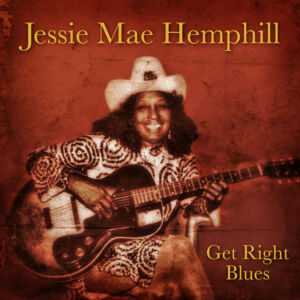
A severe stroke in 1993 paralyzed her left side and ended her guitar playing and touring career. It did not entirely silence her. Hemphill continued singing and playing tambourine, increasingly turning toward gospel. In 2004 she returned on Dare You to Do It Again, a gospel project featuring her voice and percussion with musicians including descendants and associates of North Mississippi blues families. That same year, Get Right Blues collected previously unreleased recordings made between 1979 and 1985, including guitar, drums, diddley bow, bells and foot tambourine performances that demonstrated just how much music Hemphill could generate herself.
Jessie Mae Hemphill died in Memphis on July 22, 2006, at the age of 82. She is buried in Senatobia Memorial Cemetery, where a Mississippi Blues Trail marker honors her contribution to the region’s music.
Key Dates & Songs
October 18, 1923 – Born Jessie Mae Graham in North Mississippi.
1967 – George Mitchell makes her earliest known field recordings.
1973 – Recorded by ethnomusicologist David Evans.
1980 – “Jessie’s Boogie” / “Standing in My Doorway Crying” – First High Water single.
1981 – She-Wolf – First album, released by Vogue in France. Key songs include “She-Wolf,” “Jessie’s Boogie,” “Honey Bee” and “Loving in the Moonlight.”
1982 – Performs drums with Otha Turner and Abe Young on Mister Rogers’ Neighborhood.
1987, 1988 and 1994 – Wins W.C. Handy Awards as Traditional Female Blues Artist.
1991 – Feelin’ Good – Wins the W.C. Handy Award for Acoustic Album. Key tracks include “Feelin’ Good,” “Streamline Train,” “Shame on You” and “Eagle Bird.”
1993 – Suffers a stroke that ends her guitar-playing career.
2004 – Get Right Blues and Dare You to Do It Again – Earlier blues recordings are collected while Hemphill returns to recording with a gospel project.
July 22, 2006 – Dies in Memphis at the age of 82.
May 7, 2025 – Posthumously inducted into the Blues Hall of Fame as a performer.
Why She Matters
Jessie Mae Hemphill preserved something older than the commercial blues record industry while making it unmistakably her own. Her droning guitar riffs, repeated one-chord figures, foot percussion and fierce rhythmic attack carried the musical DNA of North Mississippi fife-and-drum music into electric blues.
She also stands out as a woman who led her own career in a rural blues tradition overwhelmingly documented through male performers. She wrote songs, sang, played guitar, drums, tambourine and diddley bow, toured internationally and could effectively become her own rhythm section. Her recordings now sit alongside those of R.L. Burnside, Junior Kimbrough, Mississippi Fred McDowell and Otha Turner as essential documents of the North Mississippi tradition. Her 2025 Blues Hall of Fame induction finally placed an official exclamation point on what the music had been saying for decades.
Jessie Mae Hemphill
Related Posts