
Willie Love, The Delta Piano Man Behind Sonny Boy Williamson’s Blues
November 4, 1906 – August 19, 1953 | Duncan, Mississippi | Delta Blues, Boogie-Woogie
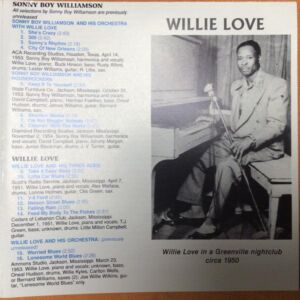 Willie Love never became a household name, but if you were hanging around the Mississippi Delta blues scene during the 1940s and early 1950s, chances are you heard his piano. And if you were listening to Sonny Boy Williamson II, you almost certainly did.
Born Willie Love Jr. on November 4, 1906, in Duncan, Mississippi, Love became one of the Delta’s most respected blues pianists, singers, and bandleaders. His music blended the sophisticated piano blues of Leroy Carr with the rolling rhythms of boogie-woogie and the rougher sounds of Mississippi juke joints.
Love spent much of his working life around Greenville, Mississippi, where Nelson Street was a center of Black nightlife and blues entertainment. Musicians passed through its clubs and cafés, exchanging songs, swapping band members, and occasionally finding someone willing to pay them.
Love was right in the middle of it.
Willie Love Meets Sonny Boy Williamson
In 1942, Love met harmonica player Rice Miller, better known as Sonny Boy Williamson II, in Greenville. The two developed a musical partnership that became an important part of the Delta blues scene.
Their performances extended beyond Greenville’s Nelson Street clubs. They worked juke joints throughout the region, often alongside guitarist Joe Willie Wilkins and drummer Willie Nix.
Love also became associated with the influential King Biscuit Time radio program on KFFA in Helena, Arkansas. The program helped introduce Delta blues musicians to audiences who might never have visited a juke joint.
By 1949, Love reportedly had his own radio program on KWEM in West Memphis, Arkansas.
His influence extended to younger musicians. Guitarist Charley Booker worked with Love after arriving in Greenville in 1947. Saxophonist and bandleader Oliver Sain, Love’s stepson, joined the musical circle as a young drummer in 1949.
These connections placed Love at the center of a remarkable network of Delta musicians.
Trumpet Records and the Three Aces
Love’s recording career began in earnest when Sonny Boy Williamson introduced him to Trumpet Records, the Jackson, Mississippi, label founded by Lillian McMurry.
Love played piano on Williamson’s early Trumpet sessions in 1951, helping create the sound heard on recordings including “Eyesight to the Blind,” “Do It If You Wanta,” and “Stop Crying.”
McMurry recognized Love’s talent and gave him opportunities to record under his own name.
On April 7, 1951, Love recorded “Take It Easy, Baby” and “Little Car Blues” in Jackson. Released on Trumpet 137, the record introduced Willie Love and His Three Aces to record buyers.
The discography identifies guitarist Lonnie Holmes, saxophonist Otis Green, and drummer Alex Wallace on that session.
Later recordings brought Love together with Elmore James and Joe Willie Wilkins. His best-known titles included “Everybody’s Fishing,” “My Own Boogie,” “Vanity Dresser Boogie,” and “Nelson Street Blues.”
“Everybody’s Fishing,” issued on Trumpet 147, became one of his signature recordings. Its lively piano and conversational vocals captured the humor and musical energy of the Delta.
Love’s December 1951 sessions also featured future blues star Little Milton on guitar, T.J. Green on fiddle, and Junior Blackman on drums.
Interestingly, despite their close friendship, Sonny Boy Williamson did not play harmonica on Love’s own Trumpet releases.
A Final Session and an Early Death
Love returned to the studio in 1953, recording “Worried Blues” and “Lonesome World Blues.”
His final recording session took place in April 1953 in Houston, Texas. Accounts describe a racially mixed rhythm section, including white bass and drum players, an unusual arrangement during the segregation era.
Unfortunately, Love’s health was deteriorating. Years of heavy drinking had reportedly taken a toll, and he developed bronchopneumonia.
He died in Jackson, Mississippi, on August 19, 1953, at the age of 46.
For decades, his grave lacked a proper marker. In 2017, the Killer Blues Headstone Project placed a headstone at Elmwood Cemetery in Jackson, finally giving the Delta pianist a visible memorial.
His recording career had lasted barely three years, but the music survived.
Key Dates & Songs
-
November 4, 1906: Willie Love Jr. born in Duncan, Mississippi.
-
1942: Meets Sonny Boy Williamson II in Greenville and begins their longtime musical partnership.
-
1942: Performs with Williamson on the King Biscuit Time radio program in Helena, Arkansas.
-
1947: Works with guitarist Charley Booker in Greenville.
-
1949: Reportedly hosts his own radio program on KWEM in West Memphis.
-
1949: His stepson Oliver Sain joins the Greenville blues scene as a drummer.
-
January–March 1951: Records piano accompaniment for Sonny Boy Williamson II’s early Trumpet sessions.
-
April 7, 1951: Records “Take It Easy, Baby” and “Little Car Blues” for Trumpet Records.
-
1951: Records “Everybody’s Fishing,” “My Own Boogie,” and “Nelson Street Blues.”
-
December 1951: Records with Little Milton, T.J. Green, and Junior Blackman.
-
March 1953: Records “Worried Blues” and “Lonesome World Blues.”
-
April 1953: Participates in his final recording session in Houston, Texas.
-
August 19, 1953: Dies of bronchopneumonia in Jackson, Mississippi, at the age of 46.
-
1991: Lonesome World Blues, a collection of his Trumpet recordings, is released.
-
2000: Greenville Smokin’ collects 18 recordings made under his own name.
-
2017: The Killer Blues Headstone Project places a grave marker at Elmwood Cemetery in Jackson.
Why He Matters
Willie Love represents an important connection between the acoustic piano blues of the 1920s and 1930s and the amplified Delta blues of the postwar era.
His playing combined Leroy Carr’s sophisticated piano style with the driving rhythms of boogie-woogie. That versatility made him a valuable accompanist for Sonny Boy Williamson II and a natural bandleader.
Love’s influence also extended beyond his own recordings. He worked alongside Elmore James, Joe Willie Wilkins, Little Milton, Charley Booker, and Oliver Sain, helping shape a musical community that would influence Chicago blues and rhythm and blues for decades.
His song “Nelson Street Blues” is especially valuable as a piece of musical history. Rather than simply describing heartbreak, Love takes listeners on a tour of Greenville’s Black business and entertainment district, mentioning actual businesses and gathering places. It preserves a glimpse of everyday life in the Delta during the early 1950s.
Although his recorded output was relatively small, his surviving Trumpet sessions document a musician equally comfortable with slow blues, boogie-woogie, and hard-driving ensemble performances.
Willie Love may have spent much of his career sitting behind the piano while bigger names stood out front, but without musicians like him, those bigger names wouldn’t have sounded quite so big.
Willie Love-V-8 Ford
Related Posts