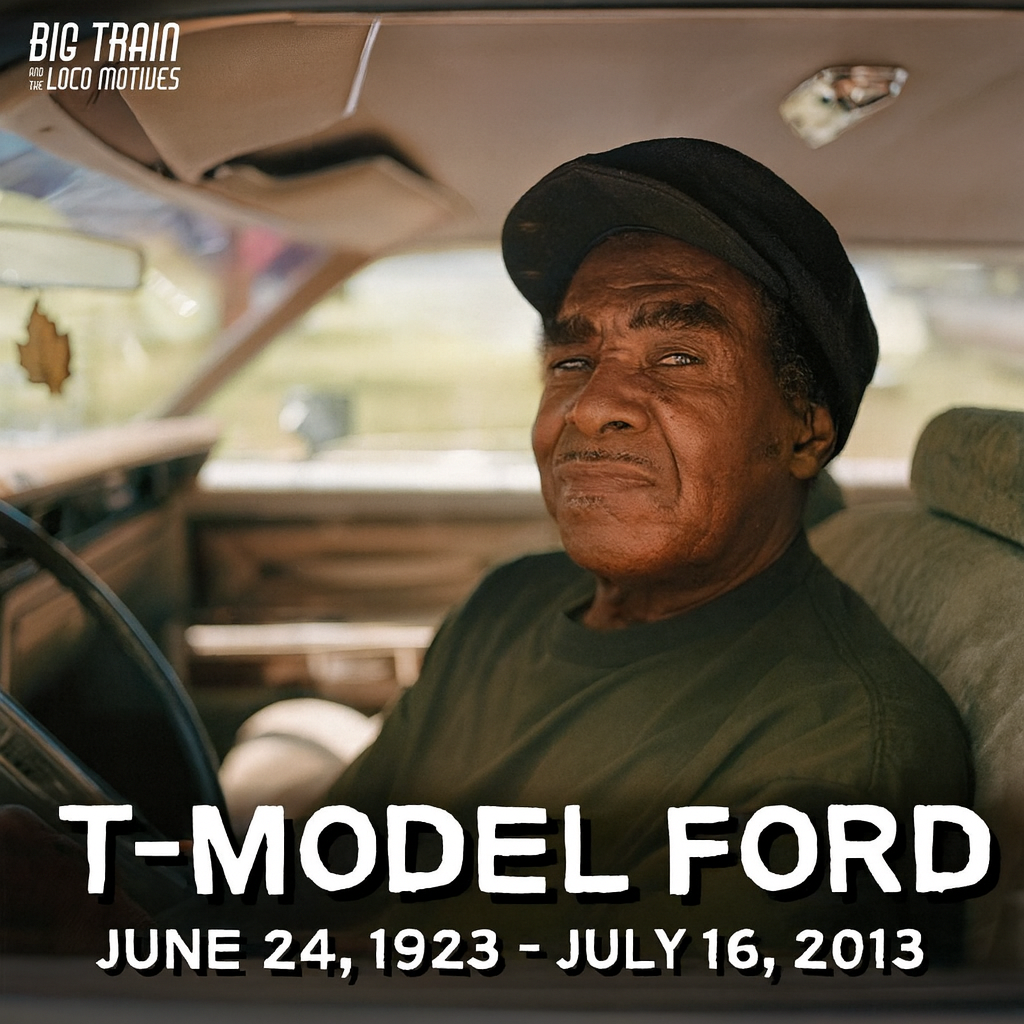
HEY LOCO FANS – James Lewis Carter Ford, better known as T-Model Ford, was one of the last great Mississippi blues originals. Although his birth date has long been debated, with documents listing years between 1921 and 1924, most blues historians recognize June 24, 1923, near Forest, Mississippi, as the most likely date. That uncertainty became part of his legend, reflecting the poor recordkeeping that surrounded many rural Southern African Americans of his generation.
 Ford’s early life was marked by hardship, violence, and relentless manual labor. Illiterate throughout his life, he worked as a farmhand, sawmill laborer, lumber company foreman, and truck driver. He frequently recounted serving time on a Mississippi chain gang after a murder conviction as a young man, claiming his original ten-year sentence was reduced after only a few years. His colorful, often contradictory storytelling became as much a part of his stage persona as his music, making it difficult to separate myth from fact.
According to Ford, he did not seriously begin playing guitar until one of his wives left him and gave him the instrument as a parting gift. Teaching himself entirely by ear, he developed a stripped-down, hypnotic playing style inspired by Muddy Waters and Howlin’ Wolf. His buzzing guitar tone, pounding rhythms, and gravelly vocals sounded unlike polished modern blues, instead capturing the raw feel of Mississippi juke joints. Performing with longtime drummer Tommy “Spam” Miles, Ford created an unmistakable sound built on little more than guitar, drums, and attitude.
Ford relocated to Greenville, Mississippi, where he became a familiar figure along the city’s legendary Nelson Street entertainment district. He reportedly fathered at least twenty-six children and, for a time, even wrote an advice column for Arthur magazine, revealing an unexpectedly humorous and thoughtful side beneath his rough exterior.
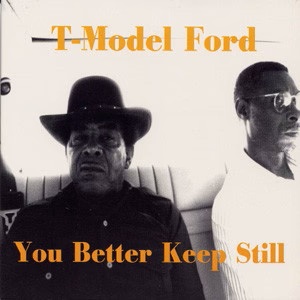
 His career changed dramatically in 1995 when Fat Possum Records founder Matthew Johnson discovered him. Ford became one of the label’s signature artists during its effort to document authentic Mississippi blues before it disappeared. Between 1997 and 2008 he released Pee-Wee Get My Gun, You Better Keep Still, She Ain’t None of Your’n, Bad Man, and Don’t Get Out Talkin’ It, recordings that earned him an enthusiastic international following. He also appeared in the 1997 documentary Juke, which introduced audiences to the surviving juke-joint culture of the Mississippi Delta.
After leaving Fat Possum, Ford joined forces with the Seattle blues-rock band GravelRoad. What began as a one-off performance evolved into a productive partnership that produced the acclaimed albums The Ladies Man (2010) and Taledragger (2011). The collaboration demonstrated that Ford’s primitive Delta grooves blended naturally with younger musicians who respected his uncompromising style rather than trying to modernize it.
 Despite suffering multiple strokes, receiving a pacemaker, and facing declining health, Ford continued performing whenever possible. His determination was evident when he returned to the stage at the 2012 King Biscuit Blues Festival after another stroke had limited his mobility. Fans admired not only his music but also his refusal to let age or illness silence him.
T-Model Ford died at his Greenville home on July 16, 2013, from respiratory failure following a prolonged illness. The following year, the Mount Zion Memorial Fund placed a permanent headstone at his grave in Green Lawn Memorial Gardens, ensuring that one of Mississippi’s last great juke-joint bluesmen would receive lasting recognition. His influence continues to be heard in contemporary roots, garage, and blues musicians who value authenticity over polish, proving that Ford’s late-blooming career preserved an essential piece of Mississippi blues history for future generations.
KEXP 90.3 FM Seattle presents bluesman T Model Ford performing with GravelRoad broadcasting live on air with John in the morning at Engine Studios in Chicago.
Related Posts