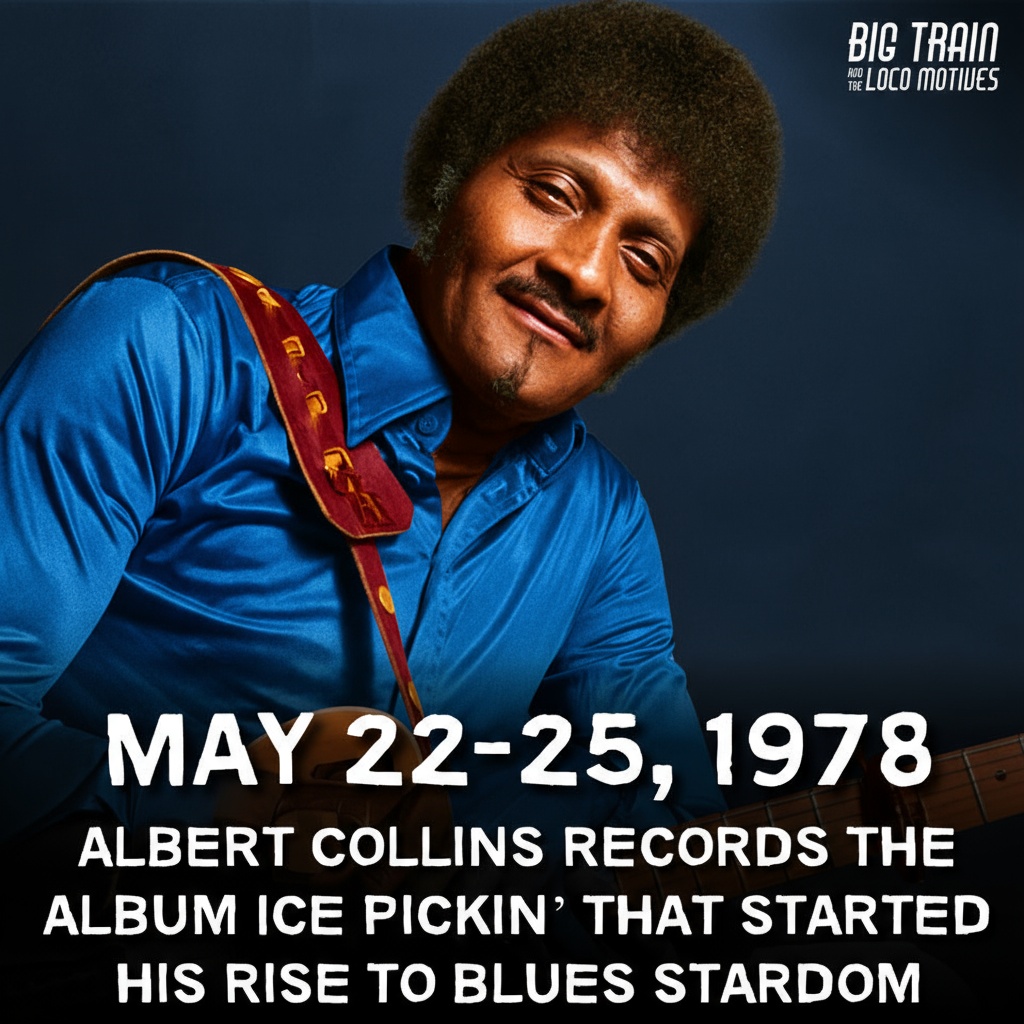
HEY LOCO FANS – From May 22 to 25, 1978, Albert Collins entered Chicago’s Curtom Studios to record Ice Pickin’ for Alligator Records. The sessions would become the defining moment of Collins’s career, transforming the Texas guitarist from a respected cult favorite into one of the biggest stars in modern blues. Although musicians had admired his icy tone and explosive stage performances for years, Ice Pickin’ introduced his talents to a much broader audience and remains one of the landmark blues albums of the 1970s.
By 1978 Collins had already built an impressive résumé. Nicknamed both “The Iceman” and “The Master of the Telecaster,” he had scored regional hits such as “Frosty” in the early 1960s and developed a highly distinctive guitar style using altered minor-key tunings, a capo placed high on the neck, and his bare fingers instead of a pick. His piercing, stinging notes and long guitar cable, which allowed him to wander deep into audiences during performances, made him one of blues’ most unforgettable entertainers. Yet despite his reputation among fellow guitarists, mainstream commercial success had remained elusive.
That changed when Alligator Records founder Bruce Iglauer signed Collins on the recommendation of producer and blues historian Dick Shurman. The label assembled an outstanding Chicago backing band featuring guitarist Larry Burton, bassist Aron Burton, keyboardist Allen Batts, drummer Casey Jones, and saxophonists A. C. Reed and Chuck Smith. Their tight, soulful accompaniment perfectly complemented Collins’s razor-sharp guitar work while giving his vocals room to shine. The album was produced by Bruce Iglauer, Dick Shurman, and Richard McLeese.
Unlike many earlier Collins releases that emphasized instrumental workouts, Ice Pickin’ balanced dazzling guitar playing with memorable songs. The album included only two instrumentals, “Ice Pick” and “Avalanche,” while showcasing Collins as an expressive singer on selections including “Honey, Hush!,” “Cold, Cold Feeling,” “Too Tired,” and “When the Welfare Turns Its Back on You.” Original compositions such as “Master Charge” and the humorous, autobiographical “Conversation with Collins” revealed his wit and personality as much as his technical brilliance. The combination produced an album that appealed equally to hardcore blues fans and newcomers discovering Collins for the first time.
Critics immediately recognized the achievement. Ice Pickin’ received a nomination for the 1979 Grammy Awards and won Best Blues Album honors at the Montreux Jazz Festival. Reviewers praised Collins’s unique guitar tone, inventive tunings, powerful vocals, and the exceptional musicianship of the accompanying band. Over time the album has been hailed by publications including Rolling Stone, DownBeat, and The Penguin Guide to Blues Recordings as one of the essential electric blues recordings of its era.
The success of Ice Pickin’ launched Collins into the most productive period of his career. A string of acclaimed Alligator albums followed, including Frostbite, Don’t Lose Your Cool, and Cold Snap. Constant international touring, legendary live performances, and collaborations with artists including Johnny Copeland and Robert Cray culminated in the Grammy-winning Showdown! in 1986. Collins’s influence extended far beyond the blues community, inspiring generations of rock and blues guitarists who admired his fearless attack and unmistakable sound.
Recognition for Ice Pickin’ has only grown with time. In 1986, the album was inducted into the Blues Hall of Fame as a Classic of Blues Recording. More than four decades after its release, it remains the recording most often recommended to listeners seeking an introduction to Albert Collins. Its combination of Texas firepower, Chicago groove, memorable songwriting, and uncompromising musicianship established a new standard for modern electric blues and secured Collins’s place among the greatest guitarists in blues history.
Albert Collins and The Icebreakers – Ice Pick – Live 1980
Master of the Telecaster as they called him those days. Guitar hero history, it swings without any doubt.
Related Posts