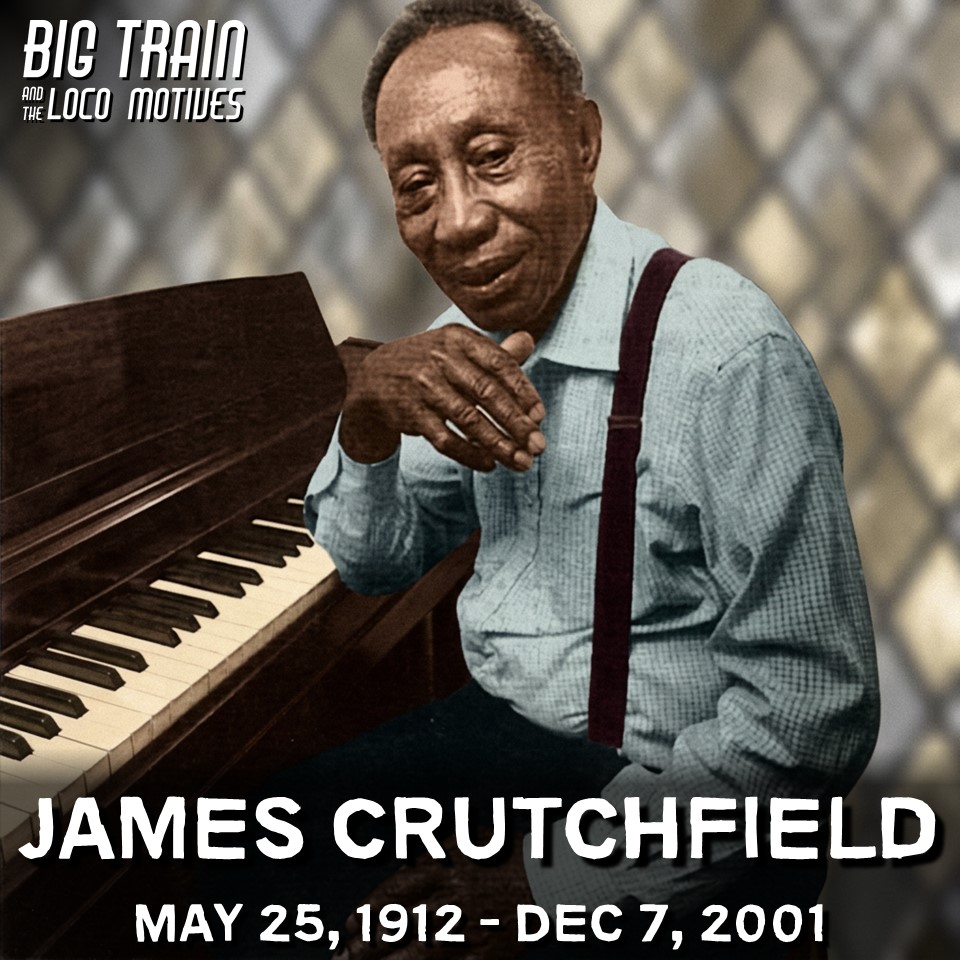
James Crutchfield was one of the last authentic links to the rough-and-tumble barrelhouse piano tradition that flourished throughout the South during the early twentieth century. Although he always claimed May 25, 1912, as his birth date, he often explained that the date was reconstructed from family memories tied to a major Louisiana flood. He was born near Baton Rouge, Louisiana, and spent much of his youth moving between Louisiana and East Texas with his family as they followed seasonal farm work.
As a teenager, Crutchfield worked in sawmills, lumber camps, and logging operations where music provided entertainment after long days of labor. In a Bogalusa logging camp, he met the influential pianist Little Brother Montgomery, who taught him “44 Blues” and helped shape his powerful keyboard style. Crutchfield later cited Montgomery, along with other Southern piano masters, as major influences on his development.
A railroad accident in 1927 cost him part of a leg, ending any future in manual labor and pushing him toward music full-time. Developing a hard-driving left hand and a rhythmic attack suited to noisy taverns, he became known for performances that could last all night. His repertoire mixed classic blues, boogie-woogie, Depression-era popular songs, and his own compositions.
Crutchfield later settled in St. Louis, where he became a respected figure on the city’s blues circuit. According to St. Louis blues historians, he spent part of his early career working as pianist for Elmore James before establishing himself as a headlining performer. In St. Louis he crossed paths with notable piano giants including Roosevelt Sykes and Henry Brown.
Though he made recordings during the 1950s, national fame largely eluded him. Instead, Crutchfield built his reputation in clubs, taverns, and neighborhood venues where his pounding barrelhouse style remained in demand long after musical fashions changed. During the blues revival of the 1980s, European audiences rediscovered him, leading to festival appearances, new recordings, and renewed appreciation for a style that was rapidly disappearing.
Known as the “King of Barrelhouse Blues,” Crutchfield became an ambassador for an earlier era of blues piano. Among his best-known songs were “I Believe You Need a Shot” and “My Baby Cooks My Breakfast.” Younger musicians sought him out for both his stories and his musical knowledge, recognizing that he represented a direct connection to the barrelhouse tradition that helped shape blues, boogie-woogie, rhythm and blues, and eventually rock and roll.
James Crutchfield died on December 7, 2001, in St. Louis, Missouri. By the time of his passing, he had spent more than seventy years performing and preserving one of the oldest surviving forms of blues piano.
James Crutchfield
Boogaloo City Blues
James Crutchfield delivers a spirited live performance of “Boogaloo City Blues,” showcasing his pounding barrelhouse piano style, driving rhythms, and authentic old-school blues energy.
Related Posts